
Roof Leak Repair in Evanston, IL — Find the Source, Fix It Permanently
A roof leak is never just a roof problem. Left unaddressed, water working its way through your roof damages insulation, rots framing, grows mold, and destroys ceilings, walls, and finishes that cost far more to restore than the original leak would have cost to fix. At J&B Home Renovations, we specialize in professional roof leak repair for homeowners throughout Evanston and Cook County. We locate the true source of the leak which is rarely where the water appears inside and fix it permanently the first time. We’ve been handling roof leak repair across the North Shore since 2014, the same team behind our full range of residential roofing services in Evanston. If your roof is leaking, don’t wait.

5—STAR RATED


10-YEAR PRODUCT
WARRANTIES
Schedule your FREE
Roof Inspection/Estimate Today!
By pressing ‘Schedule FREE INSPECTION’ you are explicitly agreeing to our terms and conditions and privacy policy, and consenting to receive emails.

Why Roof Leaks in Evanston Need Immediate Attention
What Happens When a Leak Goes Unaddressed
Evanston’s climate leaves very little margin for a leaking roof. From November through March, water that finds its way through your roof doesn’t just drip — it freezes, expands, forces entry points wider, and creates ice conditions that accelerate structural damage. During spring thaw and storm season, sustained rain means a small leak becomes a significant intrusion event quickly. In summer, trapped moisture in insulation and framing creates the warm, humid conditions where mold establishes itself fast.
The damage pattern from a roof leak is almost always worse than what’s visible. By the time a water stain appears on your ceiling, water has typically been traveling through your attic insulation, along rafters, and across sheathing for longer than you’d expect. The stain is where the water ran out of places to go — not necessarily where it came in.
What a Roof Leak Can Damage If Left Unaddressed:
- Attic insulation — saturated insulation loses its thermal value and becomes a moisture reservoir
- Roof sheathing and decking — prolonged moisture causes rot that can require structural repair
- Rafters and trusses — wood framing weakened by water infiltration compromises structural integrity
- Ceiling drywall and finishes — water staining, bubbling, and eventual collapse
- Interior walls — water that travels down wall cavities damages insulation, framing, and finishes
- Mold and mildew — establishes within 24–48 hours in wet building materials and spreads rapidly
- Electrical systems — water and wiring in the same space creates fire and safety hazards
Why Roof Leaks Are Harder to Find Than They Look
The Source Is Almost Never Where the Water Appears
This is the single most important thing to understand about roof leak repair — the location where water appears inside your home is almost never directly below where it entered the roof. Water enters through a small breach, then travels along the path of least resistance across sheathing, down rafters, along insulation, and through ceiling penetrations until gravity pulls it out somewhere visible. That point of visibility can be several feet — sometimes much more — from the actual entry point.
This is why homeowners who attempt to seal the area directly above an interior stain so often find the leak continues. The entry point hasn’t been addressed — only the exit point has been looked at.
Locating a roof leak accurately requires systematic investigation of the most common failure points across the entire roof system, combined with experience reading how water moves through building assemblies. It’s one of the diagnostic skills that separates experienced roofing contractors from general handymen with a tube of caulk.
Where Roof Leaks Most Commonly Originate in Evanston:
- Flashing around chimneys — the single most common source of roof leaks on Evanston’s older homes
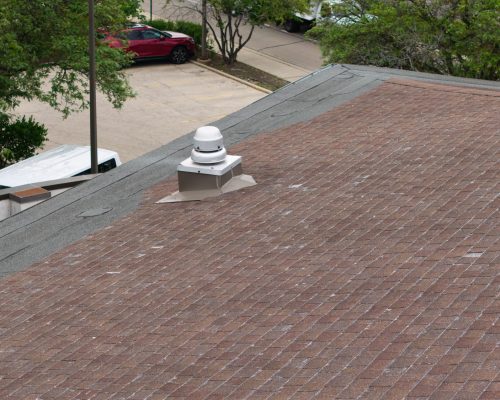
- Flashing at pipe penetrations and vent boots — deteriorated rubber collars crack and separate over time
- Valley flashing — where two roof planes meet, water concentrates and flashing failures are common
- Skylight perimeters — improperly installed or aged skylight flashing is a frequent leak source
- Ridge caps — lifted or cracked ridge caps allow water entry at the roof’s highest point
- Shingle edges at eaves — ice dams force water back up under shingles along the eave line every winter
- Dormer walls — where vertical siding meets the roof surface is a common flashing failure point
- Gutter-related entry — water backing up from blocked gutters infiltrates under the first course of shingles
- Nail pops — fasteners that back out over time create small but effective water entry points
- Membrane seams on flat roofing — separation at seams on low-slope sections is a reliable leak source
Our Roof Leak Repair Process
From First Call to Permanent Fix
Systematic Leak Investigation: We don’t start by looking at the ceiling stain and working straight up. We inspect the full roof system — every flashing condition, every penetration, every valley, every transition — and identify all breach points, not just the most obvious one. A roof with one active leak often has secondary failure points developing nearby. We find them all.
Interior Assessment: We inspect the attic space to trace the water path from where it entered to where it appeared inside. This helps confirm the entry point and assess the extent of any secondary damage to insulation, sheathing, or framing that needs to be addressed alongside the repair.
Clear Diagnosis Before Any Work Begins: We explain exactly what we found, where the leak is originating, what caused it, and what the repair involves — before we start. No vague descriptions, no surprise scope changes mid-job.
Permanent Repair: We repair the source of the leak, not just the symptoms. Depending on the cause, that may mean reflashing a chimney, replacing deteriorated vent boots, resealing valley flashing, replacing lifted or cracked shingles, or addressing a flat roof membrane seam. The repair is done to last — not patched temporarily and scheduled for a return visit.
Secondary Damage Assessment: After completing the repair, we assess any damage to decking, insulation, or structural members caused by the water intrusion and advise on remediation. If structural damage is beyond the scope of roofing repair, we tell you clearly and can refer appropriate contractors.
Documentation: Every roof leak repair is fully documented — photos of the entry point, the cause, and the completed repair. This record is useful for homeowner’s insurance claims and for your own maintenance history.
Common Roof Leak Scenarios in Evanston
What We Find Most Often on North Shore Homes
Chimney Flashing Failures: Evanston has an enormous number of older homes with masonry chimneys — and chimney flashing is the leading cause of roof leaks in the area. Flashing separates from mortar joints, step flashing rusts or lifts, and counter flashing loses its seal over time. A chimney leak often appears as staining on the ceiling several feet from the chimney itself, which leads many homeowners to look in the wrong place. We re-flash chimneys completely when the flashing system has failed rather than attempting to seal over deteriorated material.
Ice Dam Infiltration: Every Evanston winter produces ice dam conditions on a significant number of homes. Ice dams form when heat escaping through the roof melts snow that refreezes at the cold eave edge, building an ice barrier that traps meltwater. That water backs up under shingles and finds entry points that would not leak under normal conditions. We repair the damage ice dams cause and address the attic insulation and ventilation conditions that allow ice dams to form — otherwise the same leak recurs every winter.
Vent Boot Deterioration: The rubber collar around every pipe penetration through your roof has a finite lifespan — typically 10–15 years before it cracks and separates. On older Evanston homes, multiple vent boots reaching end of life simultaneously is common. These are straightforward repairs that make an immediate difference.
Skylight Perimeter Leaks: Skylights are one of the most common leak sources on Evanston homes that have them. Skylight frames expand and contract differently than the surrounding roofing material, which stresses the flashing seal over time. Condensation is also sometimes mistaken for a leak. We identify whether water is coming from outside or forming from interior condensation and address the correct cause.
Valley Flashing Failures: Where two roof planes meet, water concentrates in volume. Valley flashing that has corroded, lifted, or been installed incorrectly handles high water volumes poorly. These leaks often appear during heavy rain events rather than light rain, which is a useful diagnostic indicator.
Flat Roof Membrane Seams: Coach houses, additions, and garages with flat roofing are common across Evanston. Membrane seam separations — particularly on older EPDM systems — are a straightforward and frequent source of leaks on these structures. We repair seams using appropriate welding or bonding techniques for the specific membrane system.
Roof Leak Repair vs. Roof Replacement
When Repair Is the Right Answer and When It Isn’t
Most roof leaks are repairable without replacing the entire roof — particularly when the damage is isolated to a specific component like flashing, a vent boot, or a localized shingle failure. A leak doesn’t automatically mean a new roof is needed, and we don’t recommend replacement when repair is the honest answer.
That said, there are situations where a leak is a symptom of a broader roof system that has reached the end of its functional life. Multiple simultaneous failure points, widespread shingle deterioration, significant decking damage from prolonged water infiltration, or a roof that has simply aged past the point of cost-effective repair are all situations where roof replacement is the more practical path.
We Recommend Repair If:
- The leak source is isolated to one or two specific failure points
- The surrounding roofing material is in sound condition
- The roof has significant remaining lifespan
- Structural and decking damage is limited to the immediate area
We Recommend Discussing Replacement If:
- Multiple leak sources are present across different areas of the roof
- The roof is 15+ years old and showing broad deterioration
- Decking or structural damage from water infiltration is extensive
- The cost of repair approaches a meaningful percentage of replacement cost
We give you an honest assessment during the inspection not the answer that generates the larger invoice.
Other Residential Roofing Services
Professional. Responsive. Local.
Why Choose J&B for Roof Repair?
Fully Licensed, Bonded & Insured for total peace of mind
Rapid Response & Emergency Services to minimize business disruption
Transparent Pricing & No Hidden Fees — detailed quotes before any work begins
Expert Technicians with Years of Commercial Experience
Advanced Equipment & Proven Repair Techniques
Extended Warranties on Repairs for added protection
Don't Let a Roof Leak Get Worse
Every day a roof leak goes unaddressed is another day water is working through your home’s structure. Contact J&B Home Renovations today for a free roof inspection and leak repair estimate in Evanston.
Fast response. Expert service. Guaranteed peace of mind.
Frequently Asked Questions
Answering your questions
Why is water appearing in a completely different location from where the roof leak must be?
This is the most common source of confusion homeowners have with roof leaks — and it’s completely normal. Water entering through a breach in the roof doesn’t fall straight down. It travels along the path of least resistance across roof sheathing, down rafters, along insulation batts, and through ceiling penetrations until it finds somewhere to exit. That exit point can be several feet or more from the actual entry point. This is why we investigate the full roof system rather than looking directly above the stain the stain tells us water came through, not where it came from.
How quickly can you respond to an active roof leak in Evanston?
For active leaks causing interior water infiltration, we prioritize same-day or next-day response depending on call volume and conditions. For emergency situations active leaks during a storm, significant water entry, or structural concerns call our main line directly and we’ll get someone out as fast as possible. We’re available 24 hours and understand that a leaking roof during a Midwest winter or spring storm isn’t something that can wait until next week.
Can you repair a roof leak that's been going on for a long time?
Yes, and the sooner the better. A long-running leak that’s been seeping slowly for months or years often causes more secondary damage than a sudden acute leak, because the water has had time to saturate insulation, work through sheathing, and establish mold in wall cavities. We repair the entry point and assess the full extent of secondary damage so you understand what else may need attention beyond the roofing repair itself.
Will my homeowner's insurance cover roof leak repair in Evanston?
It depends on the cause. Leaks resulting from sudden storm damage, hail, wind, or falling trees are typically covered under standard homeowner’s policies. Leaks resulting from gradual deterioration, deferred maintenance, or wear and tear are generally not. We document the damage and its likely cause thoroughly, which helps clarify what happened and supports your claim if coverage applies. If you’re unsure, we recommend notifying your insurer and letting the documentation drive the conversation.
Don’t Let a Leaky Roof Disrupt Your Business.
Roof Problems Can’t Wait. Act Now.
A leaking commercial roof can lead to lost revenue and major damage.
Let J&B Home Renovations fix the issue before it gets worse.